Things I’ve Thought About
Before I begin, a caveat.
This is in no way a defence of Israel, the IDF, or the citizens who have supported and defended actions that violate international law. Understanding how people come to believe certain things is not the same as excusing what they do because of those beliefs. But understanding matters. It is a solid foundation upon which progress can be built. If we want to understand how conflicts like this continue generation after generation, we must be willing to examine uncomfortable truths.
And there is a truth here that many people are reluctant to acknowledge: The Israelis are victims.
But not in the way they’d have you believe.
We are all born into cultures. None of us chooses the nation, religion, or historical narrative that we inherit. These things are handed to us long before we have the intellectual tools required to question them. From our earliest years, we are taught who we are, who we should trust, and who we should fear.
We are given stories about our history. Stories about our enemies. Stories about the dangers that surround us. By the time we are old enough to examine those stories critically, they have already become the lens through which we see the world.
This is not unique to Israel. Every society does it.
Britain teaches its children certain stories about empire.
America teaches its children certain stories about freedom.
Every nation constructs a narrative about itself that justifies its existence and explains its conflicts. And we are, each of us, the heroes of our own stories.
Very few people see themselves as villains. Most of us believe we are acting in defence of something — our nation, our people, our security, our survival. That is how systems sustain themselves… Israel is no different.
From a young age, Israeli citizens are raised within a national narrative built around survival. The trauma of history, particularly the Holocaust, sits at the centre of national identity. The message, repeated generation after generation, is simple and powerful: the world is dangerous, people hate us, the Arabs are beneath us, and our survival depends on strength.
Within that framework, Palestinians and the wider Arab world are often presented primarily through the lens of threat, who are undeserving of the same rights and dignity.
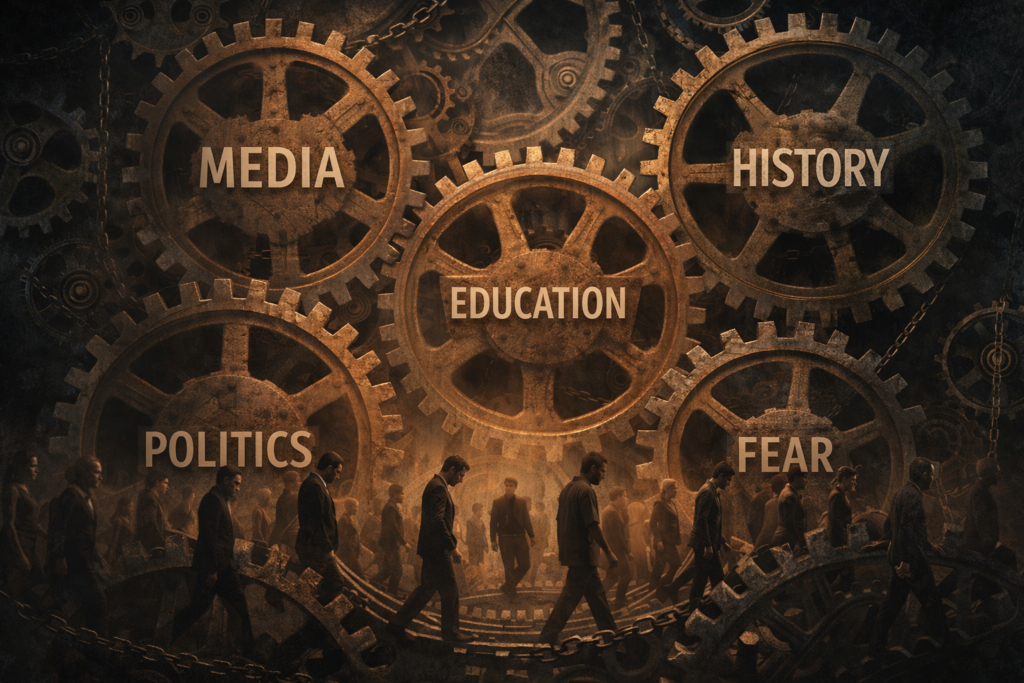
If you grow up hearing the same message from your schools, your media, your politicians, and even your family, it becomes the water you swim in. It shapes your perception of reality itself.
What feels justified.
What feels necessary.
What feels like self-defence.
In that sense, Israelis are victims.
Victims of a system of conditioning that they did not design and did not choose.
But recognising this cannot become an excuse. Adults are responsible for the actions they support and the systems they uphold.
Humanity learned this lesson the hard way in the twentieth century. After the horrors of two global wars that claimed millions of lives, the international community established principles of law based on a simple idea: being raised inside a system, or following orders within it, does not absolve individuals of moral responsibility.
Understanding how people come to accept violence is not the same thing as absolving them of responsibility for it.
If anything, understanding the system makes the responsibility clearer because systems do not exist independently of the people who sustain them.
Every soldier who enforces them.
Every politician who defends them.
Every journalist who repeats their narratives.
Every citizen who refuses to question them.
All of them, knowingly or unknowingly, help keep the machine running. And each of them should be held accountable for their role in these crimes. Civil society requires it for its survival.
But the uncomfortable truth is that this dynamic is not unique to Israel.
All of us, in all societies, live within systems we did not create. Systems that shape our beliefs, our fears, and our understanding of what is right and wrong.
In many ways, our conscious selves are passengers in our own lives.
We inherit identities, assumptions, and loyalties long before we understand where they came from.
But there comes a moment in every thinking person’s life when the passenger becomes aware of the road, when we begin to question the narratives we were raised with, when we start to see the systems around us more clearly. And that moment changes everything... Because from that point forward, ignorance is no longer an option.
If you are not the architect of the system that governs you, then you are its victim.
But once you recognise the system, you must decide whether you will continue to build it.